NAPPA
Diaper cover for infant sleep assessment
-
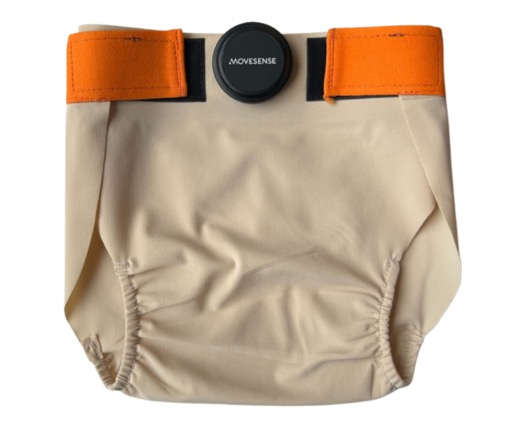
NAPPA with the sensor on the front of the waistband
- Sizes
- —
- Ages
- 0-24 months
- Sensor positions
- One sensor on a snap-on mount at the front of the waistband, laminated between the textile layers
- Material
- Pull-up textile diaper cover with an adjustable Velcro waist
- Washing
- Machine washable at 40 °C with standard detergents, sensor removed
- Analyses
NAPPA — NAPping PAnts — is a diaper cover with one movement sensor at the front of the waistband. It goes on over the infant's own diaper at bedtime, like an ordinary pair of sleep pants, and the Velcro waist is tightened so that the sensor sits firmly against the belly. From that one position the sensor picks up three things at once: the small rise and fall of the belly with each breath, the infant's body position, and how much they move.
The sensor does its own computing. Through the night it turns the raw signal into a handful of sleep-related measures and stores them in its memory, so no phone has to stay near the cot and nothing is streamed. In the morning the night is downloaded and uploaded for analysis, and comes back as a hypnogram of the infant's sleep, with breathing, position and arousals alongside.
What comes back from a night
- Sleep detection
- Every 30 seconds of the night classified as wake, light sleep (N1/REM) or deep sleep (N2/N3), shown as a hypnogram and a continuous sleep depth trend, with the totals. Agreement with polysomnography 78% across 33 infants aged 2 weeks to 18 months.
- Breathing rate
- Breathing rate and regularity every 30 seconds, from the movement of the belly. Median error 1.5 breaths per minute against capnography, reported for the stretches where the breathing signal passes an automatic quality check.
- Body position
- Supine, prone, left or right side, head up or head down, every 5 seconds — and how much of the night was spent in each.
- Activity and arousals
- Movement every 5 seconds, akin to actigraphy, and night-time arousals detected from it at durations from 30 seconds to 10 minutes, separated into calm and restless.
How a night is recorded
- Dress. Clip the sensor to the mount on the front of the waistband, put NAPPA on over the diaper at bedtime, and tighten the waist.
- Start. Start the recording in Tessalogger. The sensor begins computing and logging on its own; the phone can be put away.
- Sleep. Nothing else to do. The published studies logged a 12-hour window each night, typically 7 pm to 7 am, for up to three consecutive nights.
- Collect. In the morning, download the night from the sensor and upload it for analysis.
Because the sensor stores computed measures rather than raw signal, a night takes little memory and no streaming. With the standard sensor memory the published studies recorded three 12-hour nights before downloading. With Movesense Flash, the battery life becomes the limiting factor for the length of recordig, reaching at least a week of data.
Why a diaper cover
Sleep has usually been studied at home in two ways: parents' diaries, which report the parents' experience of the night, and a wrist or ankle actigraph, which counts limb movement. Neither measures the infant's sleep directly, and actigraphy is confounded by the brief limb twitches all sleeping infants make (Pediatric Research 2026, review).
A sensor on the belly sees more. Breathing becomes more regular in deeper sleep, and a sensor at the waist, held in the same place every night by the garment, can follow it together with position and movement. The same standardised placement is what lets the measures be compared from night to night and infant to infant. There is no camera and no microphone: the recording contains movement data only, which is not identifying in itself and avoids the privacy concerns of video in the bedroom (Heliyon 2024).
One limit is worth knowing. A single sensor cannot tell the infant's own movement from movement imposed on them — a parent turning over in a shared bed, a pram, a car. For nights spent co-sleeping or on the move, a short sleep diary alongside the recording helps interpret the data.
What parents said
In the validation study, 16 parents who had used NAPPA at home answered a structured questionnaire. All of them considered it safe, none saw skin marks or changes in their infant's behaviour, all found it as comfortable for the infant as ordinary clothing, and all were willing to use it again. Two asked for a pull-up style with an adjustable waist, which is the design in use now (Heliyon 2024).
Fit, washing and reuse
The sensor mount is encapsulated between the textile layers by heat lamination, so it holds the sensor in the same position and orientation over a whole night. Tighten the waist enough that the sensor moves with the belly rather than sliding over it.
Take the sensor off before washing. The pants are machine washable at 40 °C with standard detergents.
Related publications
-
Assessing infants' sleep in the home setting: designing rational study approaches
-
Assessing infant sleep quality and arousals: comparison of wearable data with parent perspectives
-
User experience of wearable infant sleep monitoring system for medical research and diagnostics
No publication on this page carries all of the selected analyses.