MAIJU
Jumpsuit for infant movement assessment
-
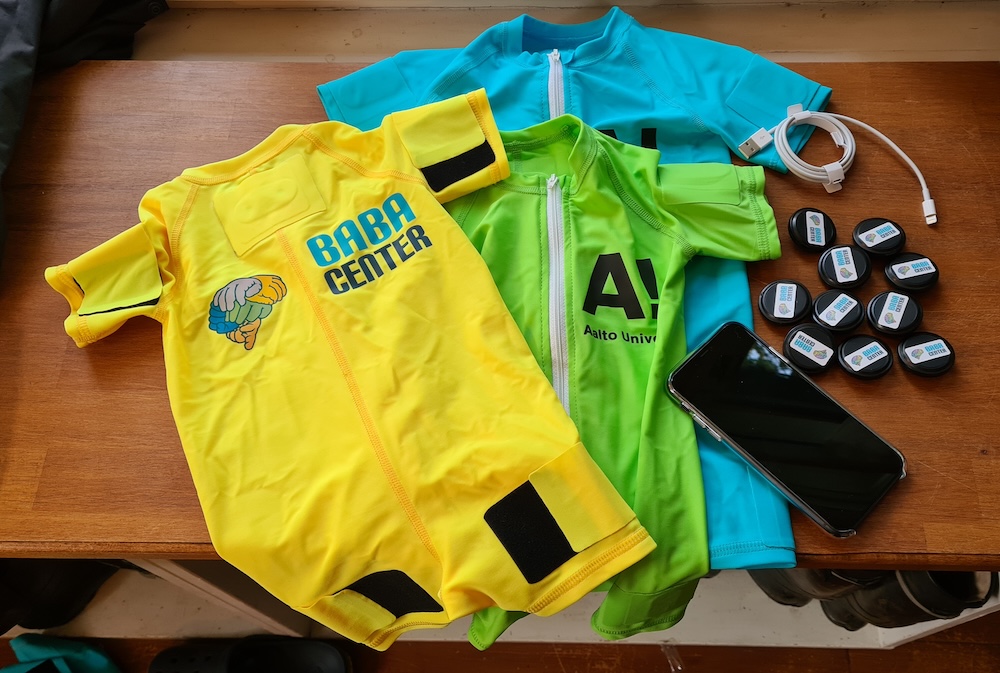
Full MAIJU recording set
-
-
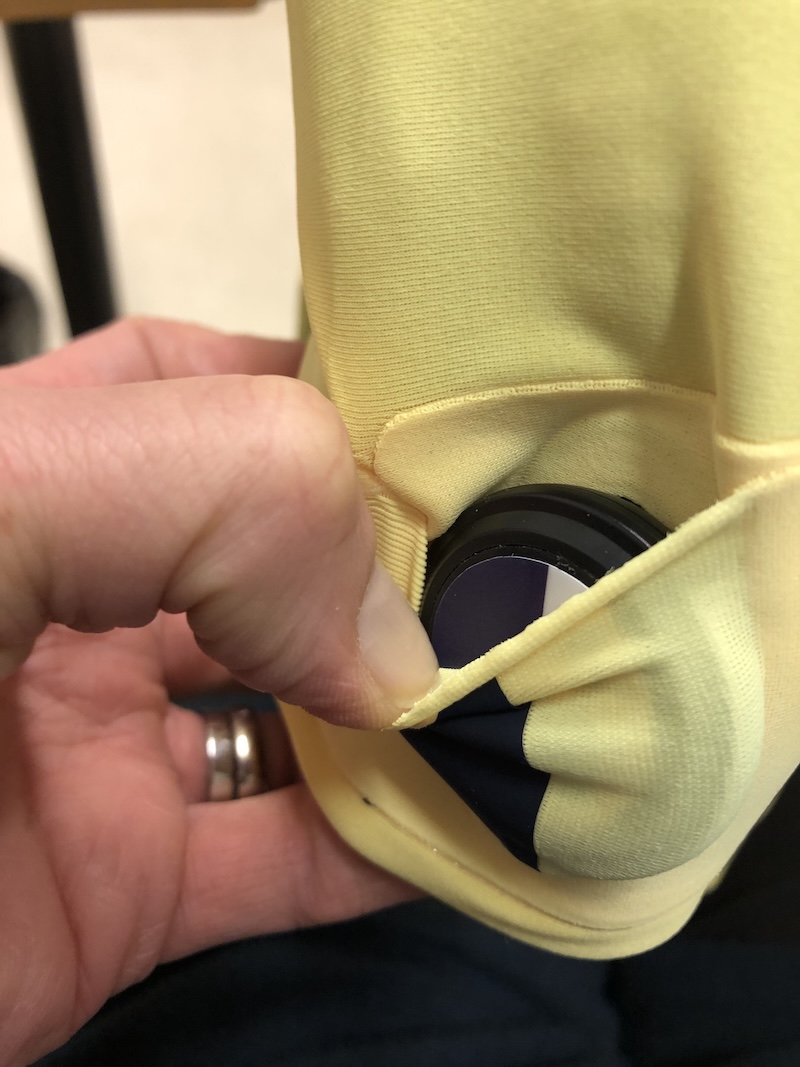
Sensor pockets
-

Empty suit
-
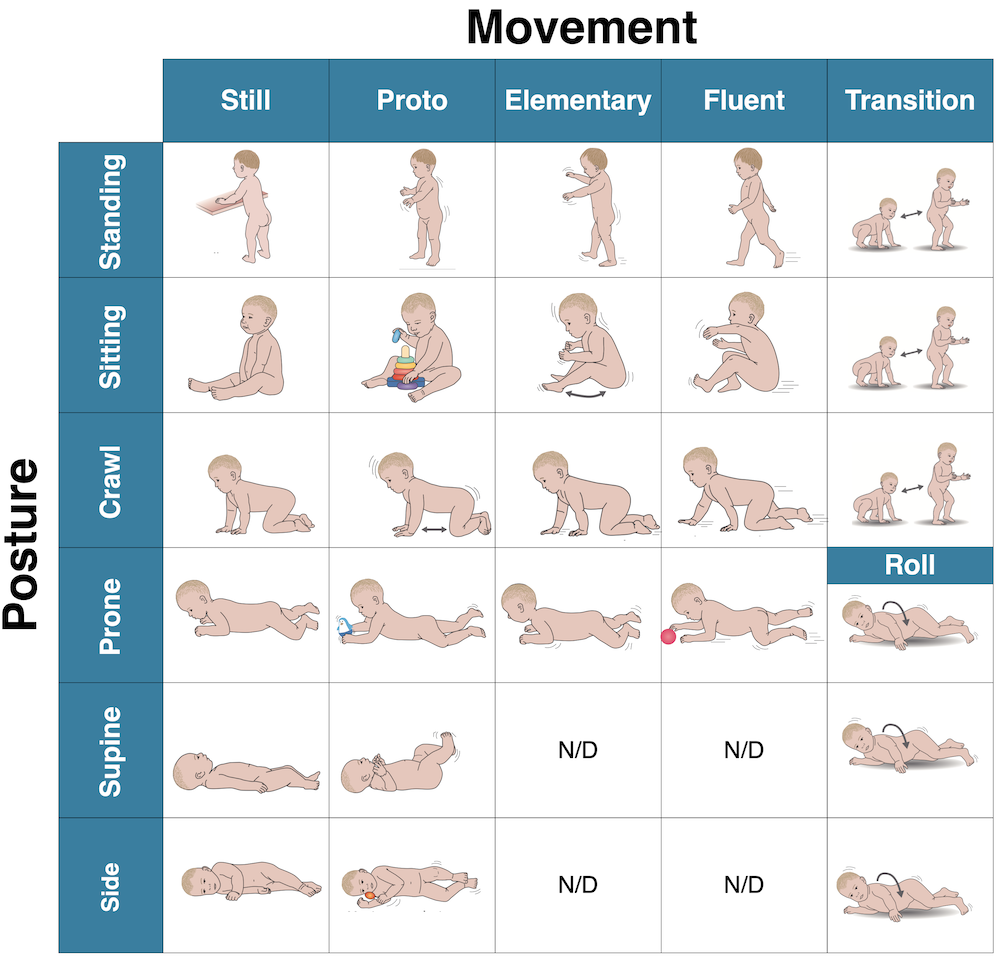
MAIJU annotation scheme for the posture and movement classifiers.
- Sizes
- 68, 74, 80, 86 and 92 cm
- Ages
- 4-24 months
- Sensor positions
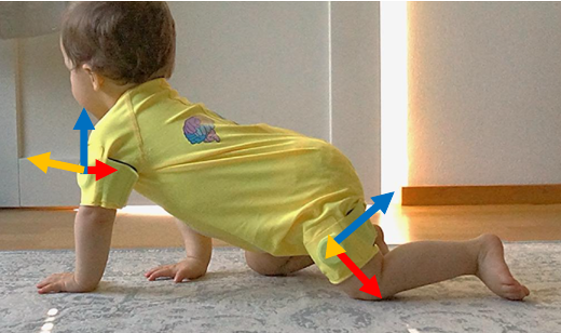
- Four pockets, proximal and lateral, on both arms and both legs
- Material
- Polyamide-elastane knit, the fabric used in swimsuits; moisture transporting
- Washing
- Machine washable with the sensors removed, detergent for synthetic materials
- Analyses
-
- BABA Infant Motor Score (BIMS)
- Posture and movement profile
- Gross motor growth charts
- Wear detection
- Playtime detection
- Carrying and holding detection
MAIJU — Motor ability Assessment of Infants with a JUmpsuit — is a full-body suit with four movement sensors, one on each limb. The sensors sit in pockets laminated proximally and laterally on the arms and legs, out of the infant's reach, and clip in on snap-on mounts. The suit goes on like ordinary overalls, with the pockets facing outwards, and fits snugly enough at each sensor position that the sensor moves with the limb.
Each sensor streams tri-axial acceleration and angular velocity over Bluetooth Low Energy to a phone or tablet in the same room. The recording is uploaded afterwards and comes back as validated developmental measures rather than raw acceleration, so a study can report motor development without first building a signal-processing pipeline.
What comes back from a recording
- BABA Infant Motor Score
- One number per recording, from 0 (lying supine, not yet rolling) to 100 (walking fluently), read against a normative growth chart. It moves gradually rather than in steps, so it works as a repeated outcome in the same child.
- Gross motor growth charts
- Motor metrics against age on normative reference curves, read the way a paediatrician reads height and weight. Percentiles and z-scores per recording, from 220 modelled metrics.
- Posture and movement profile
- Every second classified into six postures and seven movement categories, plus the distributions and transition dynamics derived from them.
- Wear and quality detection
- Which parts of a recording carry usable data from enough sensors.
- Playtime detection
- The free-playtime segments inside a long recording — what the motor analyses are computed on.
- Carrying and holding
- Time the infant was carried or held by an adult, separated from their own movement; detected at 96% accuracy against video annotation.
How a recording is made
- Fit and start. Clip the four sensors into the pockets, check the pairing in the app, and dress the infant as you would in ordinary overalls.
- Record. An hour or more of free play at home. The phone or tablet stays in the same room; the family carries on with an ordinary day.
- Upload. The recording goes to the cloud analytics when the session ends. Nothing is computed on the device.
- Collect the results. Per-recording variables, ready to take into a statistical package.
A recording is analysable when it contains at least 30 minutes of detected free playtime with data from at least three sensors. An hour or more is better: the error of the motor score stabilises once a recording passes about an hour, and the published sessions average around two hours of playtime.
Fit, washing and reuse
The fabric is a polyamide-elastane knit of the kind used in swimsuits: it stretches to fit variable body shapes, transports moisture, and tolerates repeated laundering. Sizes run 68 to 92 cm, and fit matters more than in ordinary clothing — a loose garment lets a sensor rotate, and the posture analyses read that rotation as movement.
Take the sensors out of the pockets before washing. Machine wash with a detergent intended for synthetic materials, then inspect the suit and the pockets for mechanical wear.
Related publications
-
At-home wearable measurements provide detailed growth charts of infant early gross motor development
-
Assessing motor development with wearables in low-resource settings: feasibility in rural Malawi
-
Early gross motor performance is associated with concurrent prelinguistic and social development
-
Assessing infant gross motor performance with an at-home wearable
-
Quantified assessment of infant's gross motor abilities using a multisensor wearable
-
Automatic assessment of infant carrying and holding using at-home wearable recordings
-
Intelligent wearable allows out-of-the-lab tracking of developing motor abilities in infants
-
Automatic posture and movement tracking of infants with wearable movement sensors
-
PFML: Self-supervised learning of time-series data without representation collapse
No publication on this page carries all of the selected analyses.